

Can a Chiropractor Help With Posture Problems?
Most people know their posture isn’t great. You catch your reflection in a store window and notice your head drifting forward, or you realize at the end of a workday that your shoulders have crept up toward your ears. Usually it’s the neck ache, the tight upper back, or the afternoon headache that finally makes you ask whether something can actually be done about it.
The short answer is yes, a chiropractor can help with posture problems. The honest answer is that chiropractic care works best as one half of the solution.
Adjustments and in-office treatment can help improve joint motion, calm irritated muscles, and ease pain associated with poor posture, which can make maintaining better posture more comfortable. The other half is what you do between visits: a few targeted exercises and a workspace that stops pulling you out of position all day.
At White Chiropractic, Dr. Curt White addresses both sides of the problem, because lasting improvement usually requires more than simply reminding yourself to sit up straight.
What “Bad Posture” Actually Means
Posture isn’t just about standing up straight. It’s the position your body settles into over and over, and your body adapts to whatever position you give it most often. For most people today, that means sitting at a desk, looking down at a phone, or driving, often for hours at a stretch.
A few patterns show up again and again. The most common is forward head posture, where the head drifts out in front of the shoulders instead of sitting balanced on top of the spine. It usually comes paired with rounded shoulders and a slumped upper back.
Lower down, long periods of sitting can leave the hips tight and the lower back either flattened or overly arched when you stand up.
None of these positions is necessarily a problem for a few minutes. The bigger concern is repetition. When the same position is held day after day, some muscles can become shortened and tight, others may become weaker, and areas of the spine may become stiff or lose some of their normal motion.
Eventually, the slouched position can stop being something you occasionally fall into and become the position your body naturally defaults to.
How Poor Posture Can Lead to Pain
Your head is heavy, and your neck and upper back muscles are designed to support it when it’s balanced over your spine. As the head drifts forward, those muscles have to work harder just to hold it up.
Over time, that additional strain can contribute to neck pain, tightness between the shoulder blades, and headaches that may begin around the base of the skull.
Stiff joints can add to the problem. When a section of the spine isn’t moving well, surrounding areas may compensate, and those areas can become irritated and sore.
In some cases, pain, tingling, or numbness traveling into an arm or leg may indicate nerve involvement and should be properly evaluated rather than assumed to be caused by posture alone.
Lower in the body, long hours of sitting can also contribute to lower back pain and stiffness, especially when you first stand up.
What Chiropractic Care Can and Can’t Do for Posture
It’s worth being straightforward here, because a lot of posture advertising promises more than any single treatment can deliver.
A chiropractic adjustment isn’t going to permanently reshape your posture on its own. If you go back to eight hours a day hunched over a laptop, your body will continue being exposed to the same stresses that contributed to the problem in the first place.
What chiropractic care can do is address some of the physical barriers that make maintaining a better position difficult or uncomfortable.
When an area of your neck, upper back, or lower back is stiff or restricted, simply reminding yourself to sit up straight may not be enough. Improving joint motion and reducing surrounding muscle tension and pain can make it easier and more comfortable to move and maintain a better position.
From there, exercise, movement, and a better workspace can help support the improvement.
How Dr. White Treats Posture-Related Problems
Every patient starts with an exam. Dr. White looks at how you sit and stand, checks the range of motion in your neck, upper back, and lower back, and identifies which areas are restricted and which muscles are tight or in spasm.
Posture-related problems rarely stay in one place. A patient who comes in for neck pain, for example, may also have significant stiffness in the upper back contributing to the problem.
Treatment at White Chiropractic may combine several approaches depending on what the exam shows.
Chiropractic adjustments are used to improve motion in areas of the spine that are stiff or restricted. Electrical stimulation may be used to help calm muscle spasm and reduce pain. Heat therapy can help relax tight tissue. Traction on a rolling table gently mobilizes the spine and may help loosen stiff areas.
Which combination makes sense depends on what Dr. White finds during the examination and how your body responds to care.
How long it takes to see improvement varies from person to person. It depends on how long the posture pattern has been present, how much pain is involved, what is contributing to it, and how consistently you make changes outside the office.
Dr. White will give you an honest sense of what to expect after he’s examined you rather than promising a timeline before he has the information to back it up.
Why Posture Matters So Much to Dr. White
Dr. White’s appreciation for spinal position didn’t start in chiropractic school.
Before he became a chiropractor, he trained at the U.S. Olympic Training Center in Colorado Springs and went on to make the U.S. Olympic weightlifting team.
Olympic weightlifting is a sport built on position. Every lift depends on maintaining control and proper positioning while moving heavy weight quickly. Small changes in technique can make an enormous difference in how the body handles that load.
His own back injury during training, and the chiropractic care that helped him return to weightlifting, also gave him firsthand experience with how pain and restricted movement can affect performance and everyday life.
You don’t have to be lifting a barbell for positioning to matter. The hours you spend sitting, driving, working at a computer, and looking at a phone place smaller but much more repetitive demands on your body.
Exercises Dr. White Often Recommends
These exercises target some of the muscles and joints commonly affected by prolonged sitting and poor posture. They’re simple enough to do at your desk or at home, and they generally work better when performed consistently rather than trying to do everything at once on the weekend.
Move slowly and stay within a comfortable range. If an exercise causes sharp pain, numbness, tingling, or worsening symptoms, stop and talk with a healthcare provider before continuing.
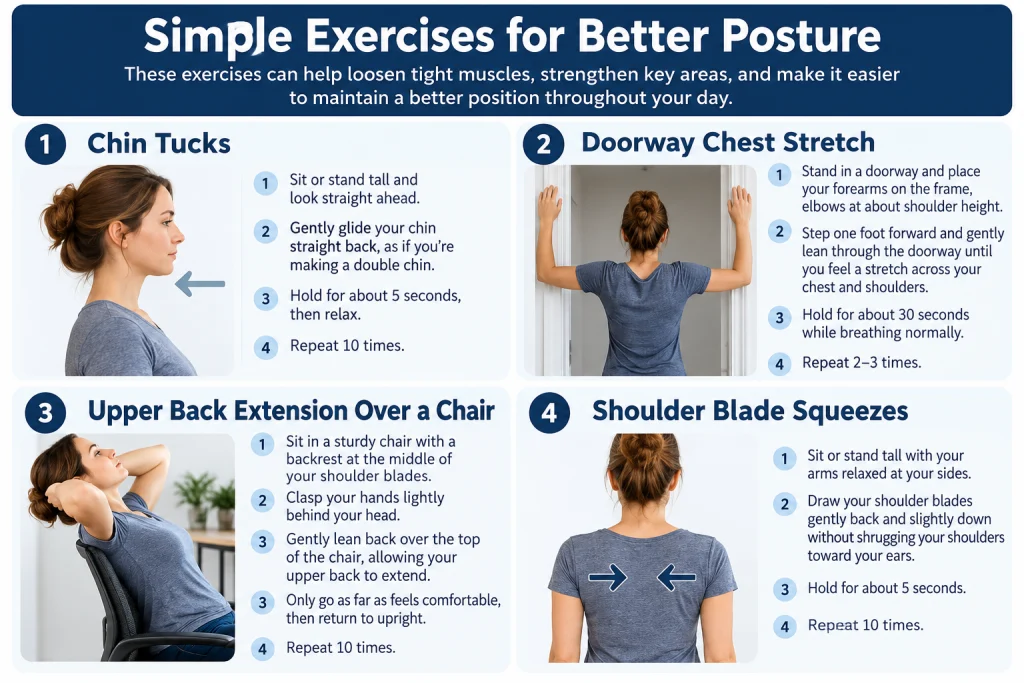
Chin Tucks
This exercise can help counter the forward-head position many people develop while working at a computer or looking at a phone.
Sit or stand tall and look straight ahead. Without tipping your head up or down, gently glide your chin straight back, as if you’re making a double chin.
You should feel a stretch around the base of your skull and a light effort in the front of your neck.
Hold for about five seconds, relax, and repeat around ten times. Doing a set periodically during long stretches at a screen can help you become more aware of where your head is positioned.
Doorway Chest Stretch
Rounded shoulders are frequently accompanied by tightness across the chest.
Stand in a doorway and place your forearms on the frame, with your elbows at about shoulder height. Step one foot forward and gently lean through the doorway until you feel a stretch across the front of your chest and shoulders.
Keep your head in line with your body instead of letting it poke forward.
Hold for about 30 seconds while breathing normally and repeat two or three times.
Upper Back Extension Over a Chair
The upper back can become stiff after long periods of desk work.
Sit in a sturdy chair with a backrest that hits around the middle of your shoulder blades. Clasp your hands lightly behind your head to support your neck, then gently lean back over the top of the chair, allowing your upper back to extend.
Only go as far as feels comfortable, then return to an upright position.
Repeat around ten times.
Shoulder Blade Squeezes
Stretching tight muscles is only part of the equation. The muscles that help support your shoulders and upper back also need to stay active.
Sit or stand tall with your arms relaxed at your sides. Draw your shoulder blades gently back and slightly down without shrugging your shoulders toward your ears.
Hold for about five seconds and repeat around ten times.
Setting Up Your Workspace
Exercises can help, but they can’t completely compensate for spending eight hours every day in a setup that continually pulls you forward.
For many people, a few practical changes to their workspace can make maintaining a more comfortable position much easier.
Put the Screen Where Your Eyes Already Are
The top of your monitor should generally sit at or just below eye level, roughly an arm’s length away.
If your screen is too low, your head will tend to drift down and forward to meet it.
If you use two monitors, center the one you look at most directly in front of you so you’re not holding your head turned to one side for hours.
If you wear bifocals or progressive lenses, you may need to adjust your screen position differently. Otherwise, you may find yourself tipping your head back to read through the appropriate portion of your lenses, which can create a different type of neck strain.
Get Your Laptop Off the Desk
Laptops create a built-in ergonomic problem because the screen and keyboard are attached.
When the keyboard is at a comfortable height, the screen is usually too low.
One solution is to raise the laptop on a stand—or even a stable stack of books—so the screen is closer to eye level, then use a separate keyboard and mouse at desk height.
If you regularly work from the couch or bed, that’s worth reconsidering too. Those positions frequently leave your head bent forward and your back poorly supported.
Set Up Your Chair to Support You
Sit all the way back in your chair so your back is supported.
If your chair doesn’t provide enough lower-back support, a small pillow or rolled towel behind the natural curve of your lower back may help.
Your feet should rest comfortably on the floor, with your knees roughly level with your hips. If your feet don’t reach the floor, use a footrest or sturdy box.
Keep your elbows close to your sides and your shoulders relaxed rather than hiked toward your ears.
Bring Your Phone Up to Your Eyes
Most people bring their eyes down to their phone instead of bringing the phone closer to their eyes.
Try holding your phone higher and resting your elbows on a table or the arms of a chair so your arms don’t get tired.
For longer periods of reading or watching video, propping the phone on a stand can be more comfortable than holding it in your lap.
Change Positions Often
Even a very good ergonomic setup can become uncomfortable if you stay in exactly the same position for hours.
Your body benefits from regular movement and changes in position.
Get up, walk around, stretch, or change positions periodically throughout the day. A reminder on your phone or computer can help until taking movement breaks becomes a habit.
When a Posture Change Needs a Medical Evaluation First
Most posture concerns develop gradually and are related to everyday habits, but some changes can point to something that deserves medical evaluation.
Two situations are particularly worth knowing about.
Posture Changes in Older Adults
In older adults, a new or worsening stoop, an upper back that appears to be rounding relatively quickly, or noticeable loss of height can sometimes be associated with changes in bone health, including osteoporosis.
Weakened bones in the spine can change its shape over time.
If you or a family member notices these changes, talk with your medical doctor about whether a bone-health evaluation is appropriate.
Knowing about osteoporosis or weakened bones is also important before chiropractic treatment because the type and force of treatment may need to be modified.
Posture Changes in Children and Teens
In children and teenagers, uneven shoulders, one hip sitting higher than the other, one shoulder blade appearing more prominent, or a visible curve of the spine can be signs of scoliosis.
Scoliosis frequently becomes noticeable during periods of rapid growth and should be evaluated by an appropriate healthcare provider.
Early identification allows the child’s healthcare team to determine whether the curve simply needs to be monitored or whether additional management is appropriate.
Symptoms That Need Prompt Medical Attention
A posture change accompanied by progressive weakness or numbness, significant difficulty with balance, or loss of bladder or bowel control should not be treated as a simple posture problem.
Seek prompt medical care for symptoms like these.
The Bottom Line
Poor posture and prolonged time in the same position can contribute to neck pain, upper back tightness, headaches, and lower back discomfort.
Chiropractic care may help reduce pain and improve restricted joint motion, but an adjustment alone doesn’t fix the habits and physical demands that contributed to the problem.
Combining appropriate chiropractic care with targeted exercises, regular movement, and a better workspace gives you a much better chance of making meaningful, lasting changes.
If posture-related neck pain, back pain, or headaches have become part of your daily routine, call White Chiropractic to schedule an evaluation and find out what may be contributing to your symptoms.
This article is for general informational purposes only and is not a substitute for professional medical advice, diagnosis, or treatment. Always consult a qualified healthcare provider with questions about a medical condition.
